The Return on Loyalty: Why Brands Need to Show It First
ㅤ
In 2026, switching providers only takes a few minutes, and comparison sites turn your brand into a line item on a leaderboard. Customer loyalty has become the defining challenge for brands in regulated sectors.
To dive into this topic, we brought together senior leaders from Smarty Mobile, Confused.com, So Energy, and the DMA for a panel event exploring why loyalty is eroding, what the data reveals about the cost of this crisis, and why, if brands want true loyalty from their customers, they need to show it first.
ㅤ
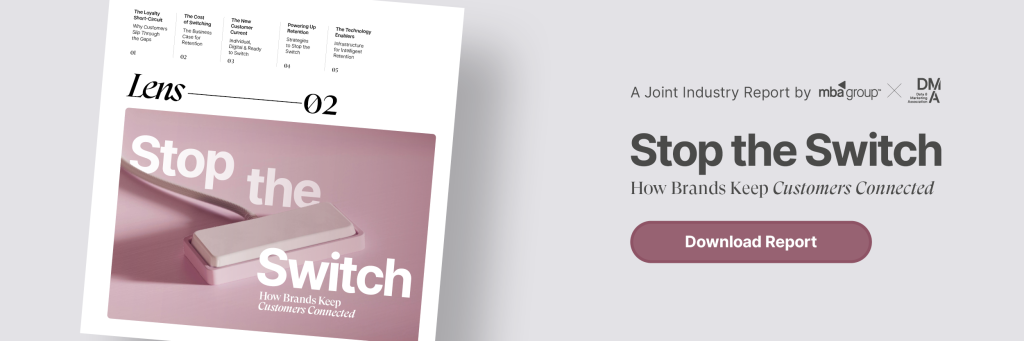
Stop the Switch
The panel event explored the findings and insights we uncovered in our latest industry report, Stop the Switch, which examines the loyalty crisis facing telecoms and utilities brands, with actionable strategies and real-world examples of effective retention campaigns.
In 2025 alone, 1.6 million UK customers switched their landline or broadband provider. In energy, over 345,000 customers switch provider every single month. That’s one switch every 75 seconds. This is happening at scale, across every regulated sector.
Download Stop the Switch to explore the full data and practical strategies for building customer loyalty.
ㅤ
ㅤ
The Scale of the Problem
Ian Gibbs, Head of Data and Insights at the DMA, opened the session by presenting findings from the DMA Effectiveness Databank that lay bare the retention crisis facing telecoms and utilities brands. The data tells a clear story: marketing in these sectors has become exceptionally good at winning customers but not as good at keeping them.
For telecoms brands, marketing drives a +32% uplift in acquisition but -27% in retention. For utilities, it’s +29% acquisition, -13% retention.
But why is that difference so costly? Retention marketing consistently delivers higher ROI than acquisition, and campaigns that achieve long-term customer loyalty are four times more likely to generate positive business outcomes. There is a clear opportunity for retention marketing to deliver high returns on investment, yet that opportunity is being missed.
ㅤ

ㅤ
Are We Buying Churn?
Richard Robinson, General Manager of Insights at Confused.com, asked the question that cuts to the heart of the issue:
“Are we buying churn?”
When acquisition strategies are optimised purely on price, brands attract customers who are already conditioned to switch. It’s a self-fulfilling cycle: the most price-sensitive customers arrive, enjoy the introductory offer, then leave as soon as a better deal appears elsewhere. The comparison site ecosystem has made this behaviour frictionless, and brands have trained customers to expect it.
But Robinson’s point wasn’t to blame the platforms. It was to challenge brands to look inward. If you’re optimising for volume and price at acquisition, you’re also expecting disloyalty from day one. Comparison sites have made the switching behaviour visible, but what matters is whether brands are using that insight to rethink who they’re acquiring and how they’re treating them once they arrive.
ㅤ
Loyalty is Reciprocal
Beckie Smith, Head of Customer Communications at Smarty Mobile, explained a principle that’s easy to state but difficult to execute:
“As a brand you need to say what you do but also do what you say.”
Your brand values can’t just live in your marketing. They have to show up in the very first interaction a customer has with you, and every single one after that, from the welcome email, to the service call and the renewal notice. If these touchpoints don’t reinforce what you claim to be, they will expose the gap instead.
Smith’s point about reciprocal loyalty speaks to something deeper: customers want consistency more than they want perfection. If you say you’re simple and honest, be simple and honest, not just in your ad campaign, but in the contract terms, the pricing structure, and the way complaints are handled. Loyalty is built on whether brands deliver on the promise they make in their marketing when it actually matters.
ㅤ
Quality Over Volume
Michael Campbell, Marketing Director at So Energy, reframed the challenge:
“It’s about encouraging the right type of customers to stay for longer.”
Some customers will churn regardless of what you do when they’re inherently price-driven and constantly scanning for better deals. Others will stay if you give them a reason. The mistake many brands make is treating acquisition as a volume game, optimising for cost-per-acquisition without considering lifetime value or propensity to stay.
Campbell’s view is that retention starts at acquisition. If you’re selecting customers based purely on who will convert cheapest and fastest, you’re building a base designed to churn. But if you’re identifying signals at sign-up, like engagement behaviours, channel preferences, and stated needs, you can start to predict who’s worth investing in and tailor retention efforts accordingly.
It’s a shift from “how many customers can we acquire” to “which customers should we acquire, and how do we make sure we keep them?”
ㅤ
Spotting the Signals
Beckie Smith returned to a critical operational point:
“What’s the least amount of data you need to know to make a decision?”
Brands often drown in data without acting on it. Churn prediction models sit unused and segmentation strategies become so complex they’re never implemented. The intent is there, but the execution falters because teams are paralysed by the volume of signals available.
Her advice was clear: identify the handful of indicators that actually predict loyalty, and act on them. Is it how customers first engaged? Whether they’ve contacted support in the first 30 days? How quickly they set up a direct debit? The specific signals will vary by sector and brand, but the principle holds: don’t wait for perfect data. Spot the patterns early and intervene.
This ties back to Campbell’s point about acquisition quality. If you know that customers acquired through certain channels, or with certain characteristics, are more likely to stay, you can weight acquisition spend toward those segments. And if you know that certain behaviours in the first 90 days predict churn, you can design onboarding and early-lifecycle engagement to address them.
ㅤ
The Path Forward
The conversation kept returning to one idea: passive loyalty is gone. The friction that once kept customers in place has been dismantled by technology, regulation, and competitors built around making switching simple.
So what replaces it?
Active, reciprocal loyalty. Brands that treat existing customers as well as they treat prospects. Brands that acquire customers with an eye to retention, not just conversion. Brands that act on early signals rather than waiting until customers are already halfway out the door.
The DMA data makes the commercial case unambiguous. Retention delivers better ROI. Long-term loyalty drives four times the business impact. But the insight from this panel event is that earning that loyalty requires brands to show it first, in pricing, in service, in how they allocate marketing spend, and in who they choose to acquire in the first place.
ㅤ
Download the full Stop the Switch report for in-depth analysis, real-world case studies, and practical strategies to elevate customer loyalty in telecoms and utilities.
ㅤ
Stay Connected
Start innovating
Your contact details
